Toe-in and anti-squat setup for Kyosho MP11 and MP11e
Master Your Kyosho MP11 / MP11e Setup: The Guide to FR and RR hinge pin Inserts for Adjusting Anti-squat and Toe-in
Welcome to all the drivers in the Kyosho family! If you are looking to optimize the handling of your Inferno MP11 (or its electric version, the MP11e), adjusting the rear end geometry is a mandatory step. At the heart of this adjustment are the famous suspension toe blocks and their eccentric inserts.
Today, we are going to decode the impact of the different positions of these inserts on the FR suspension holder (Front-Rear, the front block of the rear suspension, often labeled RF by Kyosho) and RR block (Rear-Rear, the block at the very back).
Get your screwdrivers ready, let's dive into the settings!
1. What are FR and RR suspension blocks for?
On your MP11, the rear lower arms are held by two hinge pins, which are themselves trapped in two aluminum holders fixed to the bulkhead:
- The FR (or RF) hanger: Located just behind the nitro engine (on the nitro version), at the front of the rear bulkhead.
- The RR hanger: Located at the very back of the chassis, behind the bulkhead, under the wing.
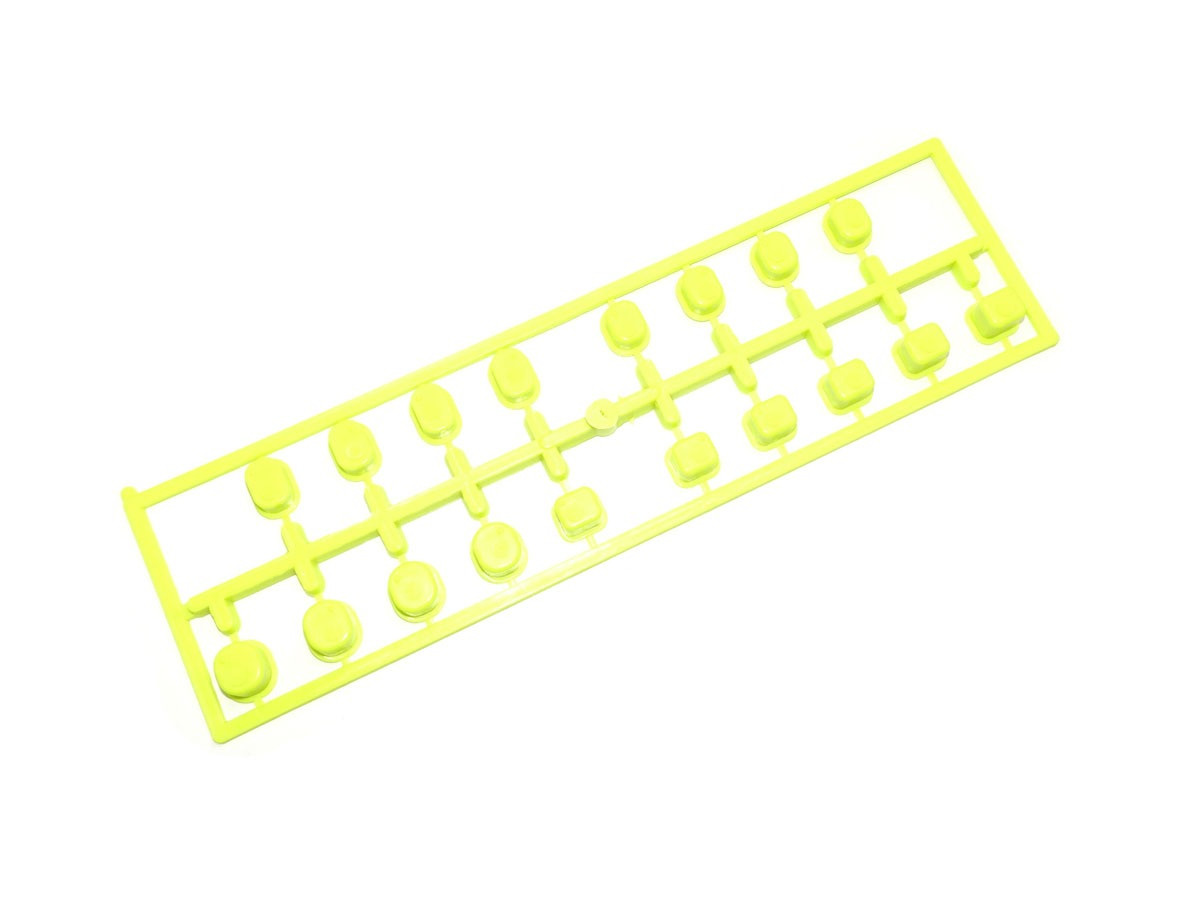
Inside these suspension holders, we place small plastic inserts with an offset hole (the famous A, B, C inserts...). By changing the orientation or type of these inserts, we modify the angle of the suspension pins. This allows you to adjust two fundamental parameters: Toe-in and Anti-squat.
On the MP11, the inserts in the RR hanger will change the toe-in, as will the position of the small dot on the RF hanger inserts. With the small dot in the same position, using A or B inserts on the RF hanger will not change the toe-in values.
2. The Horizontal Axis: Rear Toe-in
Toe-in determines the angle of the rear wheels relative to the center axis of the car when viewed from above. It is adjusted by moving the inserts from left to right, mainly on the RR hanger.
- Increasing Toe-in (RR inserts towards the outside): This gives the car phenomenal traction and stability under acceleration. The rear end is "locked." This is ideal for very slippery or bumpy tracks. In exchange, you lose a bit of top speed and the car will rotate less effectively in tight corners. If the track has high grip, the car might snap loose violently.
- Decreasing Toe-in (RR inserts towards the inside): The car "frees up." You gain corner speed and the rear rotation (the pivot) is sharper. This is the perfect setting for high-grip tracks (astro, carpet, high-bite dirt) where excess toe-in would make the car feel too sluggish.
Pro Tip: Always remember to keep your settings symmetrical between the left and right sides to ensure the car handles predictably!
3. The Vertical Axis: Anti-squat
Anti-squat determines the inclination of the suspension pin when viewed from the side. It is adjusted by moving the inserts up and down, often by adjusting the FR hanger (to raise or lower the front of the pin) relative to the RR hanger.
- Increasing Anti-squat (FR insert higher than RR): The car squats less at the rear during acceleration. This gives an "extra punch" sensation with instant traction coming out of corners, and the car generally jumps more aggressively (the nose tends to stay lower).
- Decreasing Anti-squat (FR insert aligned with or lower than RR): Rearward weight transfer is made easier. The suspension absorbs large holes and bumpy sections much better under acceleration. The car is easier to drive on very rough terrain but may feel a bit soft on power.
It is also possible to increase anti-squat by rotating the RR pills (small dot down). This will also affect the roll center height, but this is a more advanced adjustment.
4. Reading and Using the Inserts (A, B, C)
Kyosho uses a system of letters (and a small dot) to identify the hole offset in the plastic square.
- The center insert often serves as the neutral point. It exists on the MP10 but is no longer used on the MP11.
- Eccentric inserts (A, B, C...) allow you to offset the pin by half a degree depending on their orientation.
The golden rule: Always ensure perfect symmetry between the left and right sides. If you place the hole toward the inside on the left, you must place the hole toward the inside on the right!
Table of toe-in values based on the RR insert positions
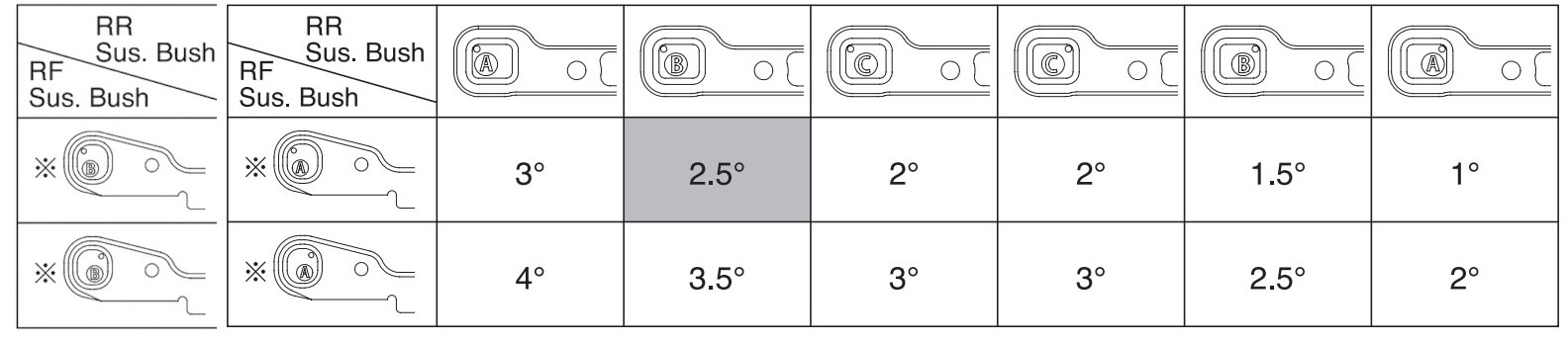
We will use the base setting with insert B and 2.5° of toe-in.
On slippery tracks, increase to 3 or 3.5 degrees.
On high-grip tracks, decrease to 2° or less.
In Conclusion
Changing the inserts on the FR and RR suspension holders of your Kyosho MP11/MP11e is one of the fastest and most effective ways to transform your chassis handling.
Only change one parameter at a time (toe-in OR anti-squat) to clearly understand its effect on the track, and take notes on your feelings.
On a slippery track, for example, after choosing the right tires of course, this is the first thing I recommend doing: increase the rear toe-in angle for more stability! It’s a quick adjustment that makes a huge difference!
Happy racing and see you on the podium!
The Shark
Reno Savoya
|