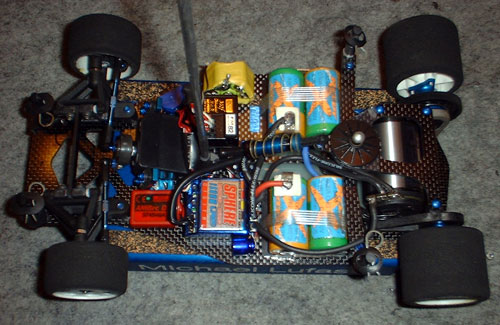

Team Associated 12L4 Setup Tips - Lufaso
| |
There are many
variables involved in setting up 12L4 radio controlled racing car that
it is nearly impossible to give a setup that will work with all tracks
and driving styles. Starting points for the various parameters involved
in building and setting up the Team Associated12L4
are shown below. Try the car in its box stock form first, before you
make any changes. At the 2005 ROAR Nationals in Tampa, FL, except for
lowered rear pod, I used the car in the box stock form (damping
discs, etc.) to win the A-main modified. At the IFMAR worlds (5th
place), I used the stock chassis and front end, with Yokomo option
parts (rear pod) to allow the use of smaller rear tires.
Set-Up sheets in Adobe PDF format
| Blank Setup Sheet |
Construction
Chassis and front armsChassis
preparation is very important. The chassis should have smooth edges
around all of the outside edges of the chassis. Fine grit (600)
sandpaper is an easy way to accomplish this. Each screw that is on the
bottom of the chassis should be mounted flush with the chassis, check
by sliding a straght edge across the assembled chassis. If the straight
edge contacts any of the screw heads, then that hole must be
counter-sunk more or the screw machined down. I prefer countersinking
the carbon fiber chassis more than removing material from the screw as
the screw may have to be replaced at some point. (Option: To the rear
outside edges of the chassis, add telflon tape to ride smoother against
the carpet in hard cornering.).
Lower and upperplate
Smooth out these pieces similarly to the chassis described above,
spending more time with the upper plate at the location the dampener
disks ride. If you have access to a mill, these pieces can be milled
slightly to reduce weight. On the upper plate use teflon tape to ride
against the dampener disk for smoother rear suspension action. On the
upper plate, replace the two button head screws on the back with blue
anodized flat head aluminum bolts and countersink the plate bolts. This
lightens the plate slightly, and allows the body to be mounted slightly
lower before the body hits the pod.
Pivot Balls
For weight savings, try CRC blue anodized aluminum pivot balls
replacing the steel pivot balls. Replace the steel screws for the pivot
sockets with light blue anodized aluminum screws (Trinity). If the
pivot ball is slightly loose, then the top of the bottom socket can be
sanded to tighten the tolerances between the two sockets. The pivot
balls should smoothly rotate in the pivot ball sockets. I use the stock
steel pivot balls, but polish the steel pivot balls to a mirror-like
finish. Periodically repolish the steel pivot ball to make the T-plate
twisting actions smoother.
Front Suspension
The back of the front arms should be filed at an angle. This will allow
smoother steering, without the steering block binding with the arm.
This will also allow you to use smaller front tires for lower
rotational weight. The front suspension should be free and smooth. The
pivotballs should be free and not loose or binding. Use polished
titanium kingpins and stub axles. One may also drill out the steel
upper suspension turnbuckle to save weight. The top pins are also made
out of titanium. Add a thin teflon shim or thin steel washer to tighten
the tolerances between the upper suspension arm mount and the upper
suspension arm. Check each side for caster, about 2-4 degrees.
Generally, if the car has high speed push, add more caster. A total of
5 degrees is the maximum that should normally be used. Note that the
same number of spacers will not necessarily result in the same degree
of caster on each side on some older pieces, but should not be a
problem with the 12L4. Use a camber/caster gauge (Team Associated or
RPM) to measure and make sure each side is the same. Use about -1.5 to
1.0 degrees of camber, which allows the tire to wear evenly. Adjust the
camber until the tire wears evenly and otherwise do not use this as a
tuning parameter.
Rear PodUsethe
Team Associated Magnesium motor plate, saving weight compared to the
stock alumimum motor plate. If you are a stock race you could use IRS
or Yokomo lowered pod blocks to use smaller rear tires. Depending on
the t-plate thickness, adjust the 2 or 3 spacers so that the chassis is
level with the rear pod, or the chassis is slightly higher that the pod
- so the chassis does not rub.
Axle Use
the Team Associated stock axle and it should fits moothly into the rear
bearing. The bearing bracket may fit too tightly into the magnesium or
aluminum motor mount. Excess material on the bearing ride height block
should be removed until the fit is not too tight. This will make the
rear axle spin much more freely, resulting in higher efficiency. This
is very important for run time.
DifferentialA
smooth and free differential is a vital component in constructing a
good handling 1/12 car. The stock Associated components create a smooth
differential. Use the stock Associated Differential grease on the diff
balls in Kimbrough gears. Typically a 100 tooth is used for modified
and in stock a smaller spur. Generally use the largest spur gear
possible possible in which you can still get proper gear mesh. Setting
the gear mesh is very important, there should be some play at the
tightest spot on the gear, but not too much play. The outside ball
bearing used as a thrust bearing will quickly wear out. I used thick
oil in the bearing, usually 5-20 weight shock oil. This prevents the
bearing from wearing out as rapidly. When finished racing for the day,
I loosen the differential so a constant side load is not placed on the
bearing. These bearings were not designed for the side loads in a
differential and wear out quickly. Consider using a slightly worn
bearing for practice, then change to a newer bearing for the races and
observe the difference in the handling of the car.
Servo MountsThe
servo mounts depends on the choice of a position of the servo, tilted
or flat on the chassis. I prefer using the tilted servo positions, use
stock adjustable aluminum servo mounts. A flat mounted servo results in
increased bumpsteer. Ball studs require spacers underneath, or an
offset ball stud to eliminate some of the bump steer.
Tires
are one of the most important aspects of the car. As a general rule for
1/12 carpet, good tires to use are Jaco Purple or Double Pink for the
front and Jaco Pink for the rear (for modified). One could try Jaco
White or Gray in stock for more efficiency. The pink dot tires are
softer and tend to wear more quickly. The outside sidewall of the tire
should be glued to the wheel with CA glue to keep it from tearing away
from the wheel. This also need to be checked after each run. If the
tire is starting to tear away from the wheel, clean up the outside edge
from with a tire trued and reglue the wheel. A tire durometer (e.g.
Maxmod) helps eliminate production tolerances inherent in the synthesis
of foam rubber. At important races, it may be useful to "match" tires.
A durometer reading can vary over 6 unit on the same compound of tire.
Tire Size
is another important aspect. The 'best' tire size is generally the
smallest in which enough traction is available for the entire 8 minute
run,and maintains enough ride height to meet ROAR rules 0.125" and not
drag or rub on track. A smaller tire generally has less rotational
mass. Typical tire size ranges are 1.78" to 1.69" on the front for a
smooth track. The rears range from 1.77" to 1.89" I typically run the
ride height near 0.150" The ride height should be high enough that the
chassis is not black after the race.
Tire Rotation
A typical road course always has more right turns than left turns if
the track run clockwise. This results in the left side tires wearing
more than the right side. I always put the larger tire on the left
side, because it will wear quicker. This should be checked after every
race. I have observed racers with as much as 0.100" difference in right
to left tire size. That makes for a car that can not possibly turn the
same left to right. Invest in a set of calipers and check tire size after every race, rotating the tires as necessary.
Ride Height
The car is riding too low when the front of the chassis/body mount
screws are blackened after a run - or the strapping tape used to hold
the cells in is blackened. There are several solutions to this,
including using the #4 offset ride height adaptors and no spacers
underneath the front blocks. Use shim stock or cut out lexan to adjust
front ride height.
Tire TractionThe
standard traction compound foruse on ozite based carpet is Paragon
Ground Effects. There are many important factors in it's use - which
can be quite an art form. The length of time the traction stays on is
important. For tracks with low traction, it should be allowed to soak
in for a longer period of time. On high traction track, a few minutes
may be all that is necessary. The amount applied is also considered -
in most cases I see racers putting on much more than necessary for the
track conditions. This can actually slow the car down as the softer
tire tend to scrub more speed - slowing the car down and reducing run
time and efficiency. The width of the application is important. The
inside 1/4 to 3/4 of the front tires shouldbe done and most often full
width on the rear tires. It is also beneficial to change tires each run
to prevent traction build up. I usually run only one set of tires twice
a day, once in practice and one in a qualifier or main.
Front Springs
Most commonly used front springs are 0.022",0.020" and 0.018" depending
on the amount of steering needed, bumps on the track, and
responsiveness desired. Various combinations of oil or grease can be
used as dampening on the kingpins. Note that using lube will require
more frequent cleaning and reapplication of dampening. In many cases,
it is more convenient to just use the polished kingpins with no
lubrication.
T-PlateThe
thick T-plate - which can vary from 0.070" to 0.080" thick is a good
place to begin for carpet. There is nearly 0.010" production tolerance
in fiberglass, so measure the T-plate to ensure what thickness you are
using. The thin T-plate is generally used for asphalt Note the thin
t-plate is more susceptible to failure and requires replacement more
often. The T-plate has the option to use 2 washers or 3 washers between
the T-plate and the rear pod. In general, the 2 washers makes the front
the back softer, making it better for the bumps and increasing rear
traction. Three washers stiffens front toback and decreases traction.
Using two washers also increases the chances that the T-plate will
become stressed. Look at the T-plate by holding it to the light. If a
noticeable color difference is present at the corners, the t-plate
needs replaced. I usually prefer to use 3 washers on carpet. I
sometimes place a small motor shim (0.010") under the font of the
T-plate, which tends to increase rear traction and is often helpful for
1/12 modified.
Damping
Very little damping is used initially when I start at a track. Add
damping to the rear end to add more steering. I have tried many types
of grease, including various oils and diff lubes (the type of diff lube
is not important, I use and try many types on the discs). The tension
on the damping discs should be very light in most cases (cut the spring
to reduce tension if necessary). Remove damping fluid to obtain more
rear traction. If a lot of damping is used then a thin T-bar may handle
better in extreme situations, but I do not typically like this setup.
Chassis Rake is
the single most under-checked parameter in setting up a 12L4 or any
onroad car for that matter. The chassis height off of the ground should
be measured at 3 distinct locations - the front end between the body
posts, the middle nearthe chassis brace, and the middle rear. The
chassis should bevery nearly level - to within 0.030" and this is
another way to tune the handling. By having the front end lower than
the rear,more steering can be obtained and conversely having the rear
end lower the the front will create less steering. Note that is valid
only toa point.
Equipment
Body
Good body choices for 1/12 are the Parma/PSE EXP Speed 8 and Protoform Speed 12. Overall downforce is good in front and rear, which results in better and more consistent handling.
PaintParma/PSE Faskolor
is a great nearly odorless paint for Lexan bodies. A wide variety of
colors is available. Airbrushing and cleanup is simple with the
non-toxic aqueous based paint.
Speed Control LRP Quantum 2is
very lightweight and highly efficient. I use setting #4 for throttle,
#0 for brake and 0 drag brake. The throttle curve is extremely linear
and easy to be smooth with. It is convenient to change wires with the
tabs outside the case. The setup is simple, and there are several
choices of throttle curves.
Servo & Receiver
1/12 racing needs a very fast servo, but does not need high torque. I currently use a KO Propo PDS-949 ICS, which has a good combination of lightweight and fast rotation speed.
Receiver Pack
A 5 or 6 cell receiver pack made of of N-cells is useful in trying to
extract the last few seconds of runtime from the main pack. The Rx pack
powers the servo and receiver, instead of draining the main pack. Note
this may only gain ~5 seconds of runtime, which can easily be lost in
one crash. Use a Rx pack to extract more performance, but only use one
if your driving/crashing is not the limiting factor (then focus on
practice). Mount the receiver so the plugs are near the center of the
chassis, so the body can be lowered even more.
TransmitterKO
Propo EX-10 Helios with the wheel drop down extension. I use tennis
wrap around the grip to make the radio more comfortable to use. A few
layers of tape attached to the brake trigger helps provide more
sensitivity for braking, which is very seldom used in 1/12 racing.
Setting up the transmitter is arguably the most important tuning aids,
and often an incorrectly setup radio is the cause of problems. When
setting up the speed control, set the throttle Hipoint to 150
(maximum), then set brake to 100. Set steering travel and EPA to 100.
Setup the speedo, then adjust the braking down to 80% as a stopping
point. Then use the steering balance to adjust the right and left end
points to the stopping point on the steering knuckles. Do a turning
circle, and reduce steering on the side with a shorter turning radius
until both sides are of equal radius. Then reduce the travel to 75%.
Adjust the braking feel and steering travel to your needs.
CellsThere
are many companies that sell NiMH, but if you are a beginner you do not
need awesome cells and can get good performance by buying lower
runtime/IR/voltage cells. The key is to learn to
mechanically/technically setup the car. When you are driving perfect
lines and not crashing for the entire 8 minute race then the better
cells will be beneficial. Try the Reedy GP 3700, or better yet, the
VTEC 3800 and you will not be disappointed with the performance.
Battery Charger The LRP Pulsar 2
is an excellent choice with a adjustable current and peak detection
limit. Try betwen 5.0 and 6.0 A with 0.005 or 0.010 mV detection. Peak
until heat reaches about 130 F.
Performance Enhancement PartsParagon
floating damping post - although it is not sold anymore. The stock
damper disks function just as well. I sometimes use the shortened
aluminum damping post by Yokomo, so I can mount the body lower.
Created October 18,1998
Modified June 21, 2006
Back to main page

