|
PTI
Racing (Performance Technologies Inc.) first got our attention
with its highly detailed Lexan bodies. The PTI Concept Mustang
body is just fantastic. In 2005, the Goliath mini monster truck
proved that PTI Racing could do more than cover up cool RC
vehicles; it could make them. Since the release of the 1¼
18-scale Goliath, rock crawling has really taken off and proven to
be one of the hottest trends in RC. Even so, no RC manufacturers
offered rock crawlers; they were all conversions until PTI
unveiled its Goliath Rock Crawler. Based on the same chassis,
drivetrain and suspension design as the original Goliath, the Rock
Crawler is 1¼ 18 scale but adds a 2-inch-longer wheelbase, huge
Imex Red Rock 2.2 tires, locked differentials and a new body, and
it is fully ready, willing and able to hit the rocks.
Round 1
I took the PTI Goliath Rock Crawler to my favorite crawling
location—my backyard. With a variety of obstacles to choose
from, I’ve run large Super-class crawlers in my rock garden and
found it challenging and fun; but most often, I run 2.2 class
crawlers that are similar to the Goliath. The 2.2 refers to the
size of tires required by the competition rules—specifically,
the rim size. The 2.2 crawlers are about 2 inches longer than the
Goliath that’s 1¼18 scale. I was curious about how the Goliath
would perform with its short wheelbase and relatively high stance.
I had also never used Imex tires for rock crawling. With the first
pull of the trigger, I realized that it needed some quick
adjustments. The torque generated by the Novak Rock Crawler
brushless system squeezed down the front end and bound the tires
into the body. Dialing in a fairly generous preload instantly
fixed this problem. Off the bench, my initial setting of just a
few turns of preload proved way too mushy. The included springs
are rather soft, and the leverage created by the cantilevers makes
the springs downright limp. Good news: it was easily fixed. Once I
had the Goliath set up a little better, I hit the rocks. The Imex
tires worked just fine; I was impressed. (The lesson here:
personal experience is valuable; Internet “experts” are not.)
The Imex Red Rocks will stay in my arsenal; they grip as well as
everything else I’ve tried at home. The Goliath Rock Crawler’s
short wheelbase hurt its performance in a few areas where my other
crawlers navigate without much ado: it fell victim to gravity and
tipped over backwards on steep climbs. But keep in mind, it’s
still box stock. The ball-bearing-supported cantilever suspension
worked exceptionally smoothly and yielded plenty of articulation.
I immediately saw that this chassis has a lot of potential. I
slowly dialed out the heavy preload and settled on a decent setup.
I wanted to lower the truck’s center of gravity, and since the
photos were all done, I hacked up the body that high-swayed in the
wind. It was off to the workshop to get busy with a set of body
scissors.
Round 2
I removed about 25 percent of the body (all around the wheel
wells), and I slammed the shell down by well over 1¼ 2 inch.
Think this won’t make a big difference? Think again. After I had
made this change and messed with the shocks a little more, the
Goliath Rock Crawler’s performance was getting pretty close to
that of a competition 2.2 crawler. With this setup, I’d start
having some fun. I still liked the big Imex tires and got a good
feel for the new and improved Novak Rock Crawler brushless system.
If you heard that the Novak system didn’t have strong enough
drag brakes for rock crawling, know that this problem has been
solved in spades. With the highest drag-brake setting, my Goliath
did rear-wheel-lifting stoppies when I let off the gas quickly—without
actually touching the brakes. Instead of wishing for stronger drag
brakes, I immediately lowered the setting. The Novak’s torque
and smooth throttle make it the best brushless system I used for
rock crawling. Rock-crawling also tests a vehicle’s durability,
and after numerous runs over a few days of testing, I’m happy to
report that nothing broke. I pulled a steering link out of a ball
end because I hadn’t threaded it deep enough; once fixed, it
never happened again. The touring-car-based spools held up fine as
did the ring and pinion gears in the axles. Overall, I’m
impressed with the Goliath Rock Crawler and can’t wait to try
PTI’s wheelbase extension when it’s available.
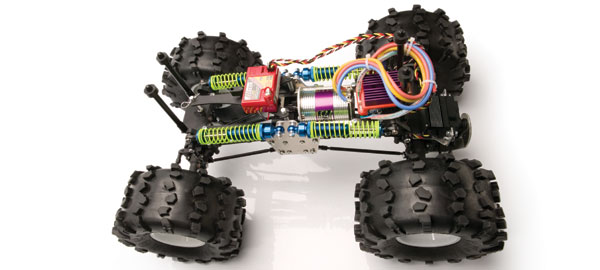
Tuning Tips
Add weight
Rock crawlers can perform nearly gravity-defying maneuvers, and
one of the common tricks to keep the front end planted is to add
weights to the inside of the rims. The easiest method is to use
model airplane self-adhesive weights such as Great Planes
segmented lead weights (item no. GPMQ4485). You can find them at
most hobby stores.
Cut the foams
Typically, you cut foam inserts on rock-crawler tires into very
pliable star patterns, but the Imex Red Rocks work best if you
only hollow out a trench down the center of each foam insert. This
leaves enough foam to give the Red Rocks the sidewall support they
need.
Tweak the preload
The Goliath Rock Crawler includes aluminum, threaded-body shocks;
take advantage of this and adjust preload to compensate for the
mushy cantilever suspension. Add more preload to the left front
shock to prevent the supension from compressing too much when you
get on the gas. Unlike race machines, rock crawlers don’t need
identical shock preload.
Hack the body
Immediately after our photo shoot, I hacked the body for extra
tire clearance. It might not look as pretty as a full-fender
truck, but not having the tires rub really improves performance.
Chassis
>> Stamped-aluminum side plates >> Square tube
frame rails The Goliath chassis is simple. The main pieces
are the 1¼ 4-inch-thick aluminum frame rails. Two thick
plastic bulkheads squeezed between the aluminum side plates
along with a plastic center skidplate help tie the two
chassis halves together. Thin fiberglass top plates finish
the job to create a sturdy chassis. The overall design is
lightweight yet should prove very durable. A plastic,
Y-shaped plate secures the battery that rides up high in the
rear of the chassis. A single clip allows easy access to the
battery.
Drivetrain
>> Full-time 4WD >> Locked differentials
>> Locked center differential >> Steel- shielded
ball bearings The drivetrain is as simple as the chassis. An
aluminum mount positions the motor between the upper frame
rails and the front of the chassis. This is excellent, as
the torque generated by the motor works to keep the front of
the Goliath Rock Crawler planted. Long motor-screw slots in
the motor plate allow a wide gearing selection. The Goliath’s
solid axles use components from Team Associated touring
cars, and PTI includes an 84-tooth Kimbrough spur gear and a
12-tooth pinion—all good stuff. Inside the axle tubes are
steel dogbones, but the center driveshafts are universal
types for smooth movement during suspension articulation.
The C-hub parts of the axles are stout and should present no
durability issues.
Suspension & steering
>> 4-link suspension >> Threaded aluminum shocks
>> Steel turnbuckle tie rods >> Cantilevers If
you’re familiar with the original Goliath, you’ll
recognize the Goliath Rock Crawler’s suspension design.
This new truck includes new, longer turnbuckle suspension
links that provide the stretched wheelbase. This, in
conjunction with the cantilever design, allows 7 inches of
articulation—more than enough for rock crawling. The Rock
Crawler version does include upgraded ball-bearing-supported
cantilevers and longer all-aluminum shocks.
The Goliath Rock Crawler has a rather new but improved
steering design. The servo now lies flat with a drag link
that runs to the right hub. A steering link connects the two
hubs.
Body, wheels & tires
>> Clear body with overspray film and precut window
masks >> Imex 2.2 Red Rock Tires >> White
RPM Torkerz rims Like the original Goliath, the Rock Crawler
is dubbed 1¼18 scale, but the longer, 10-inch wheelbase,
bigger body and large 2.2 Red Rock tires make it much more
like a 1¼ 10-scale crawler. It’s a little short compared
with a competition 2.2 rig, but it hardly seems 1¼ 18
scale. The Red Rock tires are extremely flexible and, as
expected, fit perfectly on the RPM rims. The PTI body doesn’t
declare a brand identity, but it has nice clean, modern
lines. The shell comes clear, so I sent mine to Zegers R/C
Graffixx for the Parma Faskolor treatment. |
|
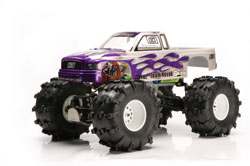
Above: the finished
product looks great, and those Imex tires are huge.
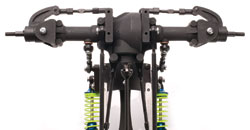
PTI designed its own axle
for the original Goliath. Inside is a spool for a Team
Associated touring car.
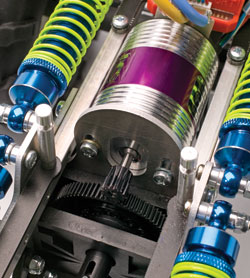
the aluminum motor mount
does a great job of pulling heat away from the motor.
|
PTI
Goliath Rock Crawler
Contact: Ptiracing.net (818) 834-8568
Price: $195 (varies with dealer)
SPECIFICATIONS
Length w/body 16.5 in. (419mm)
Wheelbase 10.5 in. (267mm)
Width 10.25 in. (261mm)
Weight as tested 3.5 lb. (1,588g)
Chassis Aluminum, square-tube ladder frame
Drivetrain type Shaft-driven 4WD w/locked
center and axle differentials
Transmission ratio 7:1
Differentials Spools
Drive axles Steel dogbone
Suspension type 4-link with cantilevers
Shocks Threaded aluminum
Upper shock positions (F/R) 1/1
Lower shock positions (F/R) 1/1
Wheels 2x2.2-inch RPM Torkerz, white
nylon w/12mm hex
Tires Imex 2.8x5.5-in. 2.2 Red Rock
w/foam inserts
Body Clear Lexan w/included masks
Electronics Not included
Bonus
>> Ready-built rock crawler—not a conversion
>> Great value; includes RPM wheels and Imex tires
>> Longer-wheelbase option
BoGus
>> Lots of hand-fitting |
|
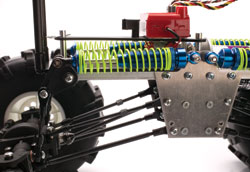
the shocks are threaded
aluminum units. Preload adjustments are easy as a result.
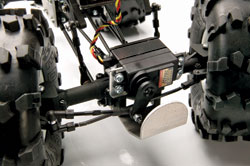
the steering setup is new
on the rock-crawling version of the Goliath. The servo is
now positioned flat.
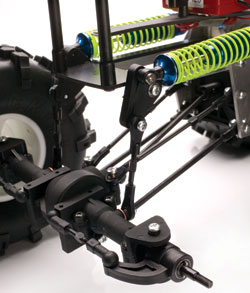
here you see the
cantilever suspension design. This setup adds a lot of
leverage on the shock.
|
On the
Bench
If you’ve never built a kit, you can certainly cut your teeth on
the Goliath Rock Crawler, but be prepared to take your time and
hand-fit a few parts.
Tight fit. It’s easier to bolt the motor to its mount before you
attach the rear upper fiberglass plate. This allows more room to
tighten down the screws.
Cantilevers. Make sure you don’t overtighten—and inadvertently
bind—the cantilevers. It’s better that they’re slightly
loose than too tight.
Thread-lock. Use
medium-strength thread-locking compound on all metal-to-metal
connections. The metal screws that are threaded into the square
chassis tubes should definitely get the thread- locking treatment.
|
You'll
Need
|
We Used
|
|
Transmitter/receiver
|
Hitec
Aggressor FM
|
|
Servo
|
Hitec
5998TG
|
|
5- or
6-cell battery
|
Tamiya
5-cell, 1800mAh sport pack
|
|
Charger
|
DuraTrax
Ice
|
|
Tire glue
|
Pro-Line
|
|
Motor and
speed control
|
Novak
Brushless Crawler system
|
|
8 AA
batteries
|
Venom
|
Kit
Ratings
Instructions 8
Photo-heavy, black-and-white assembly manual with plenty of good
tips. Parts fit & finish 5
Lots of hand-fitting required, but the finished product comes out
solid. Adjustability & maintenance 8
Easy to work on and easy to adjust.
Performance Ratings
Power 9
The gearing on the Goliath Rock Crawler provided plenty of wheel
speed and abundant climbing power. Turn radius 7.5
Like most crawlers with locked differentials, the Goliath Rock
Crawler makes fairly wide turns. Articulation 9
The Goliath Rock Crawler boasts an impressive 7 inches of
articulation. Any more, and you’d just get in trouble. Stability
8
Even with the motor and battery up high, the Goliath Rock Crawler
is surprising stable. A careful line and smooth throttle will keep
this truck on all fours.
THE VERDICT
PTI deserves a lot of credit for releasing the first production
rock- crawler kit. Compared with how much converted crawlers wind
up costing, the Goliath Rock Crawler is an exceptional value at
around $200. This kit also has plenty of potential, and although
it isn’t intended to be used in hardcore rock-crawling
competitions right out of the box, with a few key tweaks, it is
just as capable as the much more expensive models. As rock
crawling continues to grow in popularity, the PTI Goliath Rock
Crawler is a good, no-fuss choice to get in on the action.
SOURCES
DuraTrax duratrax.com
Hitec hitecrcd.com
Imex imexrc.com
Novak teamnovak.com
Pro-Line pro-lineracing.com
PTI ptiracing.net
RPM rpmrcproducts.com
Tamiya tamiyaamerica.com
Venom venom-racing.com
|